
User-centered logic: what professionals really need
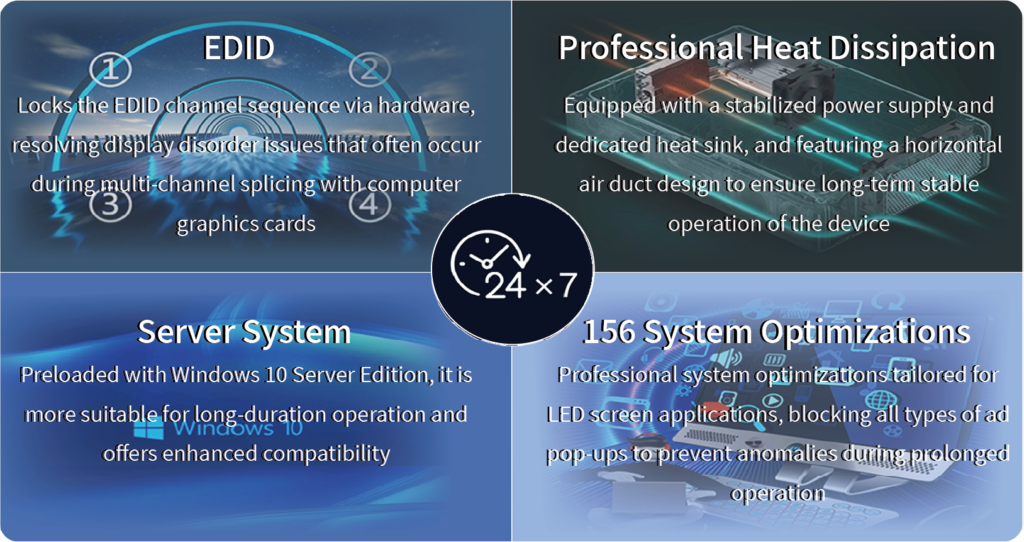
Designers and technical directors want systems that reduce setup time, stabilize content playback, and scale predictably for large audiences. A strong solution addresses signal routing, failover and simple content management without sacrificing fine control over pixel mapping and frame synchronization. Early on, consider a reliable playback media server as the operational backbone: it centralizes media, supports refresh rate matching and gives editors the tools to test content before it reaches the LED controller.

Core capabilities that lower operational risk
Focus on features that translate into fewer show-day surprises. Essential capabilities include support for dual mode operation (local playback plus networked streaming), robust frame synchronization across multiple cabinets, and flexible pixel mapping tools that handle irregular arrays. These functions ensure consistent LED video control across varied venue types—from museums to live sports productions where timing and synchronization mirror the standards seen in Times Square New Year’s Eve or major Super Bowl halftime setups, events that demand precise frame alignment for audiences numbering in the millions.
How dual mode design helps teams on-site
Dual mode systems separate concerns: one path handles local, low-latency playback for critical cues; the other manages centralized content distribution for large canvases. This separation yields clear operational roles—content designers focus on creative timing; technicians manage network and LED controller health. Practically, that means a technician can isolate a failed node without stopping content playback on redundant hardware—minimal interruption, maximum confidence. And when networked systems are required, the same architecture supports coordinated event control across staging zones via deterministic protocols.
Deployment checklist and common mistakes
Successful deployments follow a short, disciplined checklist: verify cabinet-level pixel mapping; test frame synchronization across the entire canvas at target refresh rates; confirm fallback behavior for local playback when network latency spikes. Teams often skip a full content run at venue refresh rate—this error reveals itself as micro-tearing or timing drift under load. Less obvious missteps include using generic media files without codec/bitrate tuning for the media server and overlooking timecode distribution to external lighting and audio systems—these are avoidable with pre-show diagnostics and standardized test files.
Alternatives and comparative insight
Not all projects require dual mode complexity. For tightly controlled installations with minimal change—digital signage or retail facades—a single robust media server with scheduled content playback may be sufficient. For touring shows, a hybrid approach that pairs a portable playback node with a centralized media server yields flexibility. Compare options by evaluating how each handles content degradation, latency under load, and the granularity of pixel mapping controls. Practical comparisons lean on direct testing: bring your most demanding timeline and run it at venue refresh rate to measure real performance.

Three golden rules for selection and success
1) Prioritize determinism: choose systems that document frame synchronization methods and support hardware timecode or deterministic network protocols. 2) Insist on clear fallback behavior: the platform must define how local playback engages when the network fails and how it reconciles content state afterward. 3) Validate with the actual load: test with the full canvas, native codecs, and the same refresh rate you will use in the field—this reveals bottlenecks in pixel mapping and content playback.
These rules point directly to vendors who treat reliability as a measurable attribute rather than a marketing phrase. The practical value is obvious: fewer show-day fixes, cleaner audience experiences, and predictable budgets. For integrated event work, that reliability is where Kystar fits naturally—its approach to media server design and event control aligns with the operational demands described here. —