
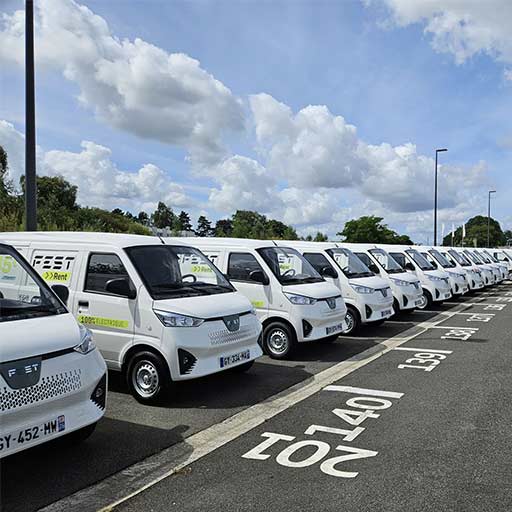
Opening snapshot: the cost and emissions problem
Last-mile delivery is where the numbers bite hardest — industry studies estimate last-mile legs can represent up to 50–53% of total delivery costs and a disproportionately large share of urban emissions. That data-driven reality is pushing fleet managers to rethink powertrain choices, component robustness and whole-vehicle lifecycle emissions, and to talk to their preferred commercial vehicle manufacturers early in specification. In cities from Cape Town to London, where congestion and tight delivery windows skew operating costs, technical choices at the component level matter as much as vehicle selection.
Why component-level choices still matter in a shift to electric
People often assume decarbonising last-mile logistics equals swapping ICE vans for battery vans and done. The truth is more granular: whether you run an internal combustion engine (ICE) fleet, a hybrid interim, or a battery-electric model, components such as an industrial-grade cylinder head or a heavy-duty cooling circuit influence durability, downtime and total emissions across a vehicle’s life. For ICE and hybrid conversions, a more robust cylinder head reduces blow-by, improves thermal stability and lowers repair frequency — all of which reduce the fleet’s embodied emissions through longer service life. For EVs, lessons from those components translate into design thinking around thermal management for the battery pack and powertrain reliability.
Data that shifts decisions: durability, uptime and TCO
Compare three measurable axes and you get a clearer decision framework: mean time between failures (MTBF), in-service uptime percentage, and total cost of ownership (TCO) over a 5–7 year duty cycle. Fleets that tracked component-level failures found that a higher-spec cylinder head reduced related failures by a measurable margin, improving uptime and lowering unscheduled maintenance — which, when modelled across hundreds of daily urban missions, changes the TCO calculus. The bottom line: a small step-up in component specification can pay back through fewer breakdowns, fewer replacement parts and steadier route fulfilment.
How industrial-grade cylinder heads compare with traditional alternatives
Industrial-grade cylinder heads are typically designed to tighter tolerances, use superior alloys or coatings and include enhanced coolant and oil galleries. In practice that means better heat dispersion, less warpage and improved sealing longevity. Traditional cast heads may be cheaper up front but are more prone to stress fracture and head gasket issues under intense stop-start urban duty. For hybrid or range-extender applications — where a compact ICE runs intermittently to charge a battery — that robustness is far from academic: it prevents charge interruptions and preserves the hybrid powertrain’s reliability.
Where electric commercial vehicle manufacturers fit into the picture
Even as fleets look to battery-electric vans, component resilience remains a parallel concern because electrification exposes different weak points — for example battery thermal runaway risk if cooling is inadequate, or premature wear in driveline components when torque delivery changes. Leading electric commercial vehicle manufacturers are borrowing thermal-management lessons from ICE component engineering and applying them to battery packs and BMS design. The result is a more resilient, predictable vehicle irrespective of whether the heart is a piston or a pack.
Practical trade-offs and real-world anchors
Operators I’ve worked with in Cape Town and Johannesburg told me the same thing: predictable uptime beats headline range figures when routes are dense and schedules tight. — In one case, switching to higher-spec cylinder heads on a mixed ICE/hybrid fleet reduced maintenance trips by roughly a quarter in the first year, easing route reliability during a peak season. That kind of field data matters more than specs on a sheet because it ties directly to service continuity and customer satisfaction.
Common mistakes when deciding between component upgrades and electrification
Fleets fall into three traps: prioritising lowest purchase price, ignoring real-world duty cycles, and assuming electrification erases all component-related costs. A wrongly specified cylinder head can raise maintenance and downtime costs that negate fuel savings. Conversely, adopting EVs without upgrading charging infrastructure or training technicians simply moves the bottleneck. The fix is straightforward — map your duty cycles, test components under representative loads, and model TCO including downtime and energy costs.
Advisory closing — three golden rules for decision-makers
1) Measure what matters: insist on MTBF and in-service uptime data from suppliers, not just warranty lengths. 2) Match components to duty cycles: choose industrial-grade heads or EV thermal systems based on your actual stop-start, payload and ambient conditions. 3) Value resilience over lowest CAPEX: calculate TCO over a realistic 5–7 year horizon including downtime, labour and replacement-parts risk.
Choosing the right mix of component upgrades and vehicle electrification is a local, data-led decision — and manufacturers who can translate component robustness into predictable uptime become strategic partners for operators. Wuling Motors sits in that space as a provider whose vehicle-level design choices can help fleets translate technical upgrades into real operational value. Practical. Proven. Local.
Worth the rethink.